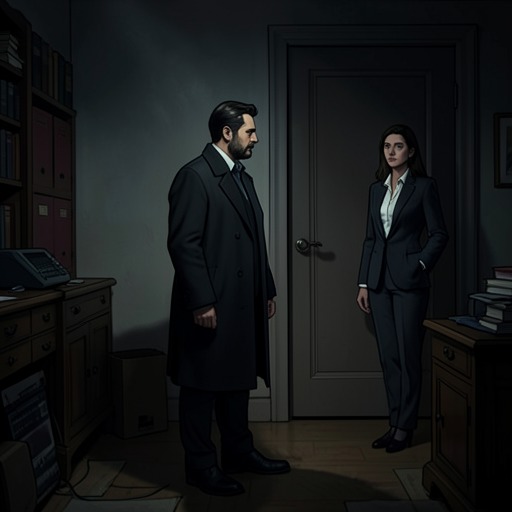
Humphrey Wells
The Portable DoorHumphrey Wells is a partner at J.W. Wells & Co. and a practicing sorcerer whose businesslike status masks a sustained campaign against his uncle, John Wellington Wells. He is introduced to Paul Carpenter among the firm’s intimidating partners, then emerges as the antagonist behind the attempt to seize control of the company. His preference for coercion and lethal magic is finally answered by a transformation that turns the machinery of the office into his punishment.
Identity and Position
At Paul Carpenter’s interview, Humphrey is the grim-faced man who identifies himself and introduces the other partners. The meeting takes place across a mirror-polished table that reflects the people on both sides, adding to Paul’s sense of being surrounded and watched. Humphrey is presented as a member of a formidable, strange-looking group, but his own name is the one Paul remembers. The company’s intimidating atmosphere is thus associated from the outset with the senior people who govern it, rather than with ordinary office procedure alone.
Dennis Tanner later explains how Paul should address the firm’s partners. Humphrey is to be called Mr Wells, a formal distinction that marks his standing within the organization. The firm’s records list him as ASTP and CHM; Tanner identifies ASTP as Associate of the Society of Thaumaturgical Practitioners. The credentials sit alongside his commercial role, locating him within both the company’s hierarchy and its magical profession.
Tanner describes Humphrey as a sorcerer working mainly in commercial and banking matters, while continuing to practice conjuring and spirit-raising, particularly for clients in the Far East and the United States. His work spans respectable-looking business services and overtly supernatural operations. That combination is central to his character: magic is not an alternative to the firm’s commercial life but one of the means by which its partners conduct it.
Conduct Within the Firm
After Paul and Sophie Pettingell have been at the firm for some time, Humphrey calls them to a meeting with Dietrich Wurmtoter present. The boardroom retains its dark paneling, polished table, chandelier, and heavy atmosphere, although it has been rotated a quarter turn since Paul last saw it. Humphrey is occupied with papers when they arrive and treats their presence as a task to be dispatched. He gives them a brief welcome and asks whether their work is going well, before turning to their recent work with Dennis Tanner on mineral-rights development and office procedures.
The scene places Humphrey’s power in an ordinary managerial form: he summons junior employees, directs the meeting, and decides what counts as important. Yet his courtesy is perfunctory, and the business setting does not make him benign. The contrast between routine administrative language and the danger that later becomes explicit helps establish how easily the firm’s offices can serve as a setting for magical violence.
Humphrey’s public conjuring also reveals the gap between professional performance and actual consequence. During a stage act, he saws a woman in a coffin in two. The audience initially sees what appears to be a familiar trick, but Paul realizes that it is not an illusion. Later, Humphrey refers to the act in the context of his murders, confirming that the apparent entertainment belongs to the same pattern of lethal conduct as his private schemes. The performance gives his magic a public face while concealing its real cost from those watching.
Conflict with John Wellington Wells
Humphrey is the nephew of John Wellington Wells, the senior partner, and their conflict concerns both control of the firm and the limits of its conduct. John has spoken of retiring for roughly two hundred years but has never done so. Humphrey, unwilling to wait any longer, conspires with two other partners to remove him. John, for his part, has no intention of surrendering the business to Humphrey: he objects to his nephew’s methods and regards them as unethical, dishonest, and wicked.
Before Humphrey’s plot comes to a head, John entrusts Paul and Sophie with a small, powerful talisman. He fears that Humphrey may transform him or imprison him, and believes the object is the only magic strong enough to secure his release. The trust puts the two employees in the middle of a family and corporate struggle; the talisman is both a safeguard for John and the object Humphrey seeks.
Humphrey discovers that Paul and Sophie know too much and will not hand over the talisman. When they experiment with a magical portable doorway, he appears on the other side and shuts it, leaving them trapped in a room without a door. His action is calculated to remove them from the conflict permanently, not simply to reprimand them. The attempt also shows that he understands the danger they pose to his plan and uses the firm’s magical resources to silence them.
The Final Confrontation
Humphrey ultimately confronts Paul, Sophie, Arthur Tanner, Pip, and the others in the boardroom. He arrives in a conjuror’s cloak and hat, holding a saw, and explains that he has transformed John, while the others do not know what form John has taken. His concern with attention to detail becomes a threat: he uses the danger facing Mr Tanner’s mum to pressure Arthur into revealing the talisman. Humphrey says he has wanted revenge on her for two hundred years, making the demand more than a calculated attempt to obtain the object; it is also an opportunity to settle an old grievance.
Arthur produces a fine gold chain from Humphrey’s conjuror’s hat and identifies it as the talisman. Humphrey is astonished to realize that he has carried the object for a hundred and thirty years without knowing what it was. He accepts it and then restores Mr Tanner’s mum after she has been divided by the conjuring act. The exchange briefly gives Humphrey what he wants, but it also exposes the absurd weakness beneath his confidence: the object on which he has built his plan was already within his possession, beyond his recognition.
John is eventually freed and transforms Humphrey into a photocopier. John explains the punishment through the office’s own hierarchy of frustration: after having been made into a stapler, Humphrey is sentenced to become the piece of equipment most hated and abused in an office, blamed when work is late or damaged. The reversal turns Humphrey’s transformation magic back upon him. The man who tried to reduce his uncle to an object becomes office equipment himself, with his professional environment recast as an instrument of retribution.
Character and Narrative Role
Humphrey’s arc is built on a contrast between authority and blindness. He has the standing of a partner, recognized magical qualifications, and a broad professional practice, yet he fails to recognize the talisman he has carried for generations. He can identify the vulnerability of others and exploit it, but his own certainty does not protect him from the object hidden in plain sight—or from the consequences of his conduct.
His conflict with John also links the company’s succession to a moral dispute. Humphrey wants the business and is prepared to use deception, imprisonment, and lethal magic to obtain it; John’s opposition is grounded in the judgment that his nephew’s practices have crossed an ethical line. Humphrey’s final transformation gives that conflict a concrete, comic form. The office equipment that surrounds and serves the firm becomes the shape of his defeat, making his punishment an inversion of the authority he had exercised within the company.